
Mid-travel cable rupture
Sometimes you'll hear a loud bang first - that's the cable letting go under tension, usually while the door is mid-travel. Don't try to force the door up or down once you notice a lean or a hanging cable end.
Beaumont, TX
Frayed or snapped garage door cables are common in Beaumont's 1960s-90s housing stock. We repair or replace cables on original drums and hardware.
Symptoms
A cable problem usually shows up in one of three ways: the door hangs crooked on one side, it slams down the last foot instead of easing shut, or it flat out won't move and you can see a loose strand of wire hanging near the bottom bracket.
Sometimes you'll hear a loud bang first - that's the cable letting go under tension, usually while the door is mid-travel. Don't try to force the door up or down once you notice a lean or a hanging cable end.
A door held by one working cable and one broken one is under uneven load, and the remaining cable, drum, or track can give way next, sometimes while the door is over your car or a person is standing under it.
Most of the calls we get for this in the Beaumont area involve either a frayed cable that's been rubbing on a bracket for months, or a cable that popped clean off a drum because the drum groove wore through. Both are cable jobs, not spring jobs, though a lot of homeowners assume it's the spring because the door acts the same either way - dead weight, won't budge.
Timing
We don't have a fixed number to give you here, because it depends on whether it's a straight cable swap or whether the drum, bracket, or track took damage when the cable let go.
A clean break on a door that's otherwise in decent shape is a smaller job than one where the cable jumped the drum and chewed up the track on the way.
What we can tell you: on a lot of the older doors around Beaumont, the original steel drums are still on there from whenever the door went in, and matching that exact drum profile sometimes takes more digging than swapping a cable that came with a newer opener system.
That's the honest limitation - if your drum is an odd or discontinued size, we may need to source a compatible replacement rather than an exact match, and that can add time to an otherwise simple repair. We look at the door in person before we quote a timeline, because guessing over the phone on a cable job is how you end up back at the house twice.
Our process
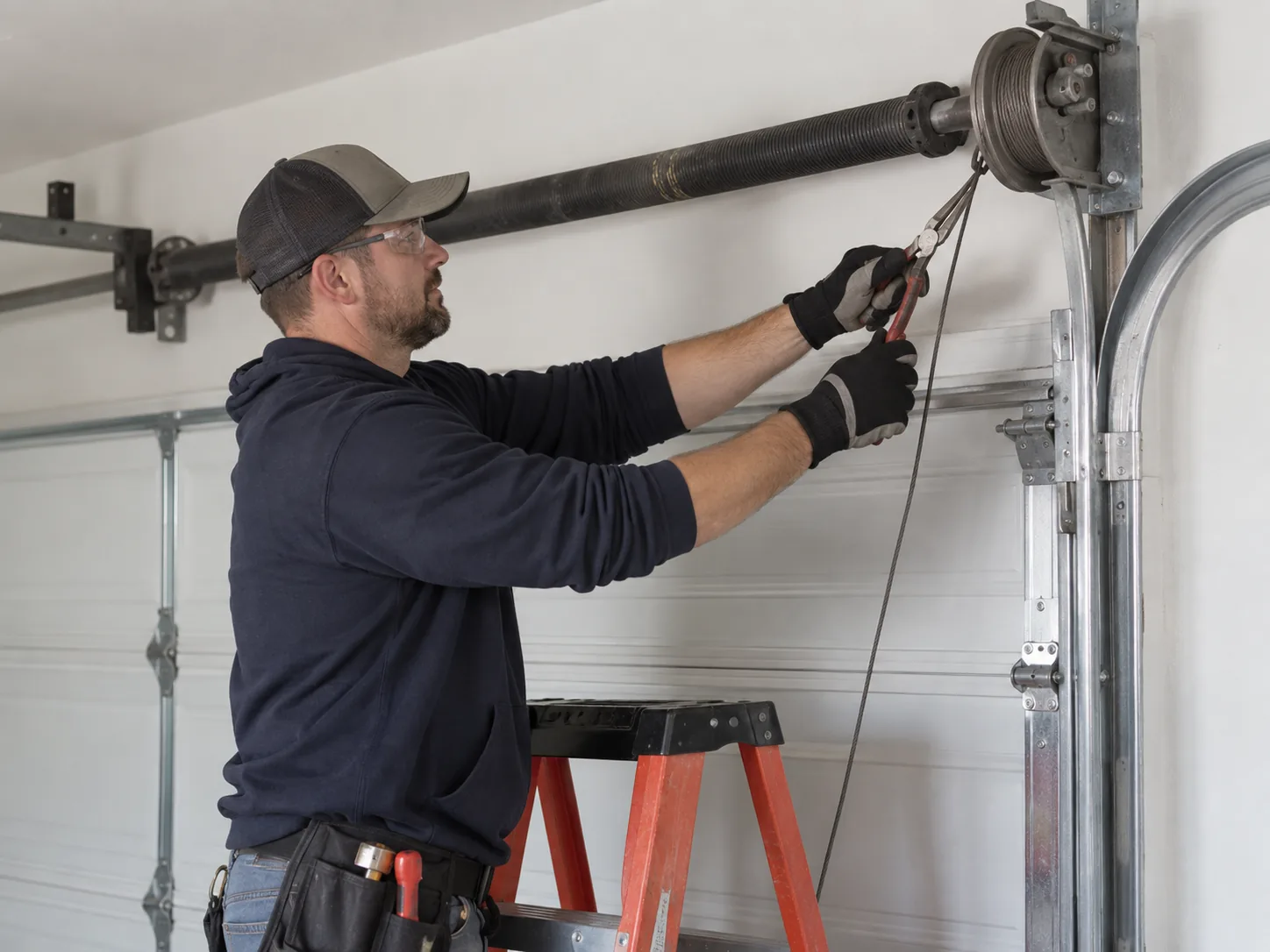
For a straight cable failure, we release the tension safely, pull the old cable off the drum, and run a new galvanized cable sized to the door's weight and track height.
We check both cables at the same time - if one went, the other has usually seen the same years of wear and is close behind it. We also inspect the drum groove and the bottom bracket while we're in there.
On a lot of Beaumont's older doors, built during the run of construction between 1966 and 1998, the drums are the original steel from install, and a worn groove is what causes a cable to jump and shear early even if the cable itself still looks fine. Replacing the cable without fixing a worn drum just buys you another failure down the road.
Once the new cable is on, we re-tension the door, run it through a full cycle by hand and by opener, and check that both sides lift evenly. If the springs are also worn from the same age and use, we'll tell you, but that's a separate call you make - we're not going to sell you a spring job you didn't ask for.
Local causes
Beaumont's housing runs mostly from 1966 to 1998, with a median build year around 1978, and that shows up directly in cable failures. A door installed in the 1970s came with a drum and cable set sized to that era's hardware standards, and 45-plus years of daily lift cycles is enough to fatigue any galvanized cable, original or replaced once already.
The climate here plays a role too. Beaumont sits in a mild band with only occasional freezes, so we don't see the hard winter snapping that colder regions get. Instead, cables here fail more from steady humidity and heat cycling - the metal corrodes slowly at the point where it wraps the drum, and that's usually where the fray starts, not out in the open span.
Across the roughly 37,000 owner-occupied houses in this service area, a large share sit in that same 1960s-70s construction wave, so a worn drum groove paired with a fatigued cable is one of the most common two-part failures we run into, not a one-off.

Questions
It rarely happens with no warning - most cables fray for months near the drum or bottom bracket before they let go. The bang you hear is the final break, but the wear built up slowly, often from a worn drum groove rubbing the same spot on the cable every cycle.
We don't recommend it. Both cables see the same years of cycling, so if one has failed the other is usually close behind. Replacing both at once also keeps the door lifting evenly on both sides instead of pulling crooked on the newer cable.
Cables and springs are different jobs with different parts, so it depends on what your door actually needs. We inspect both before quoting, since a cable can fail on its own or alongside a worn spring, and we won't quote a spring replacement you don't need.
We try to match the drum profile on doors from Beaumont's older housing stock, but some original drums are discontinued. If we can't get an exact match, we'll use a compatible replacement and tell you before we install it, not after.
Explore more
Ready when you are
Beaumont Garage Door Pros repairs and installs garage doors, springs and openers in Beaumont, TX and the surrounding area.